

How Many Syllables In Ladybug
Ladybug, ladybird, ladybeetle. Whatever you call them, it'due south always a joy to spot one of these adorable creatures in your garden.
But have yous ever looked at ane closely? Always wonder how they see the world?
Like most insects, ladybugs have 2 chemical compound eyes. They tin't meet colors merely tin see different directions at once. Their eyes lack night vision, and things are apparent only when they are near them. Instead, they can aroma, touch on, and experience their environs with their antennae very well.
Just do they see things the manner we practise? What tin can and what tin't they see?
Read on to find out more about how these little creatures come across and sense the world!
Anatomy of a Ladybug
Like all insects, ladybirds accept 3 main body parts: head, thorax, and abdomen. They accept an oval-shaped trunk with six legs, two wings, two antennae, and two eyes. Well-nigh ladybugs are nigh 4-8 mm long.
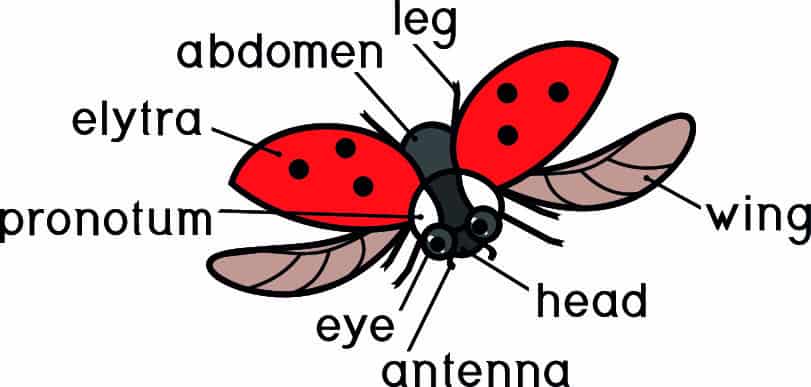
The dear critter has a circular and thin head, featuring its mouth, eyes, and antennae. An organ right behind the head, called the pronotum, makes the head look round and big, and information technology protects the head in unsafe situations.
The thorax is where the legs, wings, and elytra come together. The elytra or the color on the wing covers is basically what makes the ladybeetle adorable because of their vivid colors carmine or orangish color and blackness spots. They human action as protective shells over the ladybug'due south fragile wings.
Finally, the abdomen holds the ladybug's internal organs, such as the digestive organisation, reproductive organs, and the musky, unpleasant gel they release when they sense danger.
Eyes of a Ladybug
Ladybugs take two compound eyes, which means they can see in all directions and recognize movements.
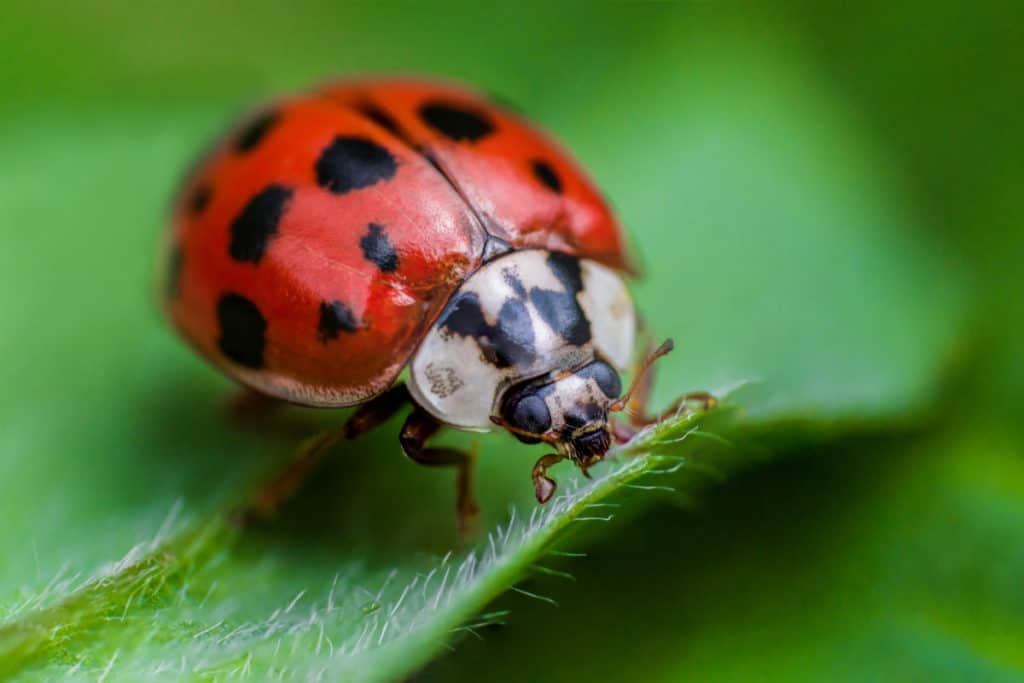
This ability is extremely helpful since ladybugs can't turn their head. The chemical compound eyes let ladybugs perceive different degrees of light intensity. Withal, they only run across in black, white, and grey.
Ladybugs are nearsighted, which means they can only see things clearly when something is near them.
Being nearsighted and seeing in grey shades might seem disappointing, simply ladybugs can see in virtually directions. They tin detect movements much more accurately than nosotros exercise. This helps them react to undesired changes. For example, if they're flying and the wind changes direction; they can rapidly recognize the change and adjust to it.
In general, insects' visual range is less than 100 anxiety, whereas this number goes to two miles or more for humans.
How Do Ladybug Eyes Office?
Almost all insects have compound eyes as a visual organ made of thousands of ommatidia. Ommatidia are contained photoreception units. They consist of the cornea, lens, and photoreceptor cells that recognize brightness and color. If the eye has more ommatidia, the prototype'southward quality is more than, and the insect can see more details.
Most insects, including ladybugs, tin can only sense light and dark. Only a few species, like bees, see a broad spectrum of colors including ultraviolet light which humans tin't see.
The image perceived past the compound eye is a combination of many inputs from all ommatidia taken from unlike directions. These inputs are like mosaics, which form a full epitome together.
So they cover a vast view angle, and they can find fast movements. This way, ladybugs can quickly hide from predators similar birds.
Nonetheless, the image chemical compound eyes produce has a depression resolution compared to a elementary center. Suppose an insect and a human being look at the aforementioned object; the human being sees more than details because the eye's acuity is about 100 times better.
Some insects have more than two optics, and some have a combination of compound and simple eyes. For example, bees have five optics: three simple and two compound ones.
How Do Ladybugs Run into at Night?
Ladybugs don't take nighttime vision because they don't take an eye part chosen tapetum lucidum—a biological reflector system in the optics of vertebrates. It'south a mirror-similar layer in the heart that reflects light outward and makes it possible to see things in the dark.
However, the absence of a tapetum isn't a problem for ladybugs because they sleep at nighttime. Ladybugs are active during the daytime because they can utilize their eyes to hunt for food. Merely during the night, they search for a shelter to rest.
They enter a stable state (stasis), where they end moving. Notwithstanding, the digestive organisation and other physical functions proceed to operate. This state lasts until morn when the sun comes up and warms the ladybugs.
Exercise Ladybugs Sleep With Their Closed Eyes?
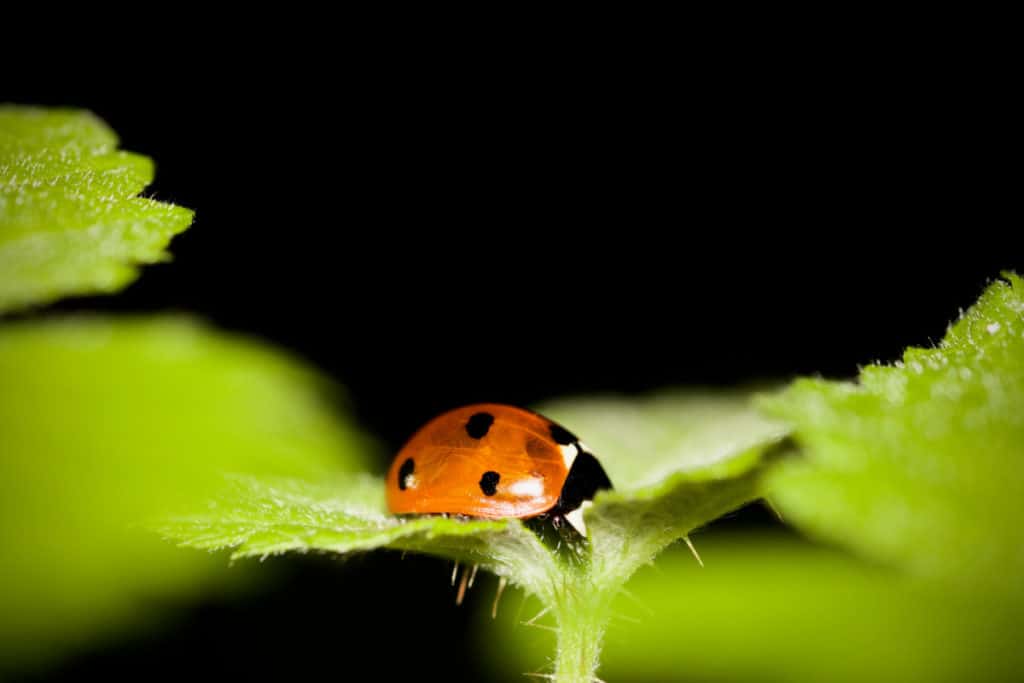
Ladybugs slumber at night, but they don't close their eyes or fall asleep the fashion nosotros exercise. They balance while they stay still and unresponsive for hours. They continue their legs under the shell and their head inside the pronotum to be safe.
Using the Antennae to Enhance Vision
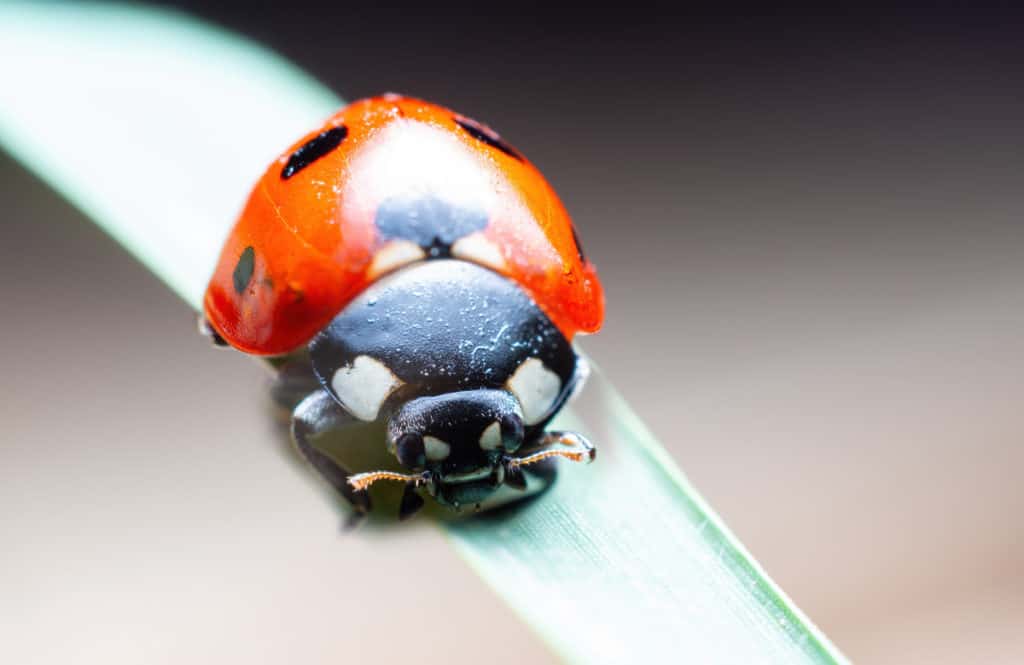
Similar about insects, ladybugs use their antennae to help them sense their environment and communicate. In this sense, the antennae deed as a second set of eyes.
So, poor eyesight isn't a big deal for ladybugs because their antennae assistance them survive in the environs.
The antennae also assistance them smell, taste, and feel their surroundings. That's why they're often chosen feelers. Insects, in full general, smell food from long distances just with the pair of antennae on their heads. They tin can also apply them to touch objects, sense hot and cold, listen to sounds, and experience the air movement.
Tin Poor Eyesight Put Ladybugs in Danger?
Ladybugs are prey to birds, small-scale mammals, and other insects, but they take an effective defense organization.
First of all, the bright ruby color on the elytra is a alert to predators. It says: "I'g toxic, and I taste awful." This biological system is called aposematism.
Moreover, ladybugs take a technique called "playing dead" to fool the predators. They don't move or even sometimes turn on their backs to play dead. They too fold their legs and release faux blood, which smells bad.
Finally, if a hunter attacks, they release a poisonous, bad-tasting, sticky gel through their leg joints to defend themselves.
Then, despite their low vision, they're non entirely defenseless, as these cute critters are far from beingness naïve.
If you are interested we do take an entire article that dives into this topic of how poisonous ladybugs are. If you lot would like to check it out the article is called, Are Ladybugs Poisonous?
Do Ladybugs Use Their Eyes to Expect for Nutrient?
Not really. Ladybugs locate food by sensing information technology with their antennae. They munch on aphids, small bugs, and soft scales. Psyllids, whiteflies, and other insects are also a part of ladybugs' diet. They can smell their meal much better than we exercise, so who needs optics!
This topic of what ladybugs similar to eat is very interesting. They can be very savage. If you want to know more nosotros accept a comprehensive article dedicated to this topic. Check it out if you like the article is called, What Do Ladybugs Eat?
Do Female and Male Ladybugs Take Different Optics?
The head office, including the eyes, isn't different in male person and female person ladybugs.
The differences are just under the abdomen—i.due east., the reproductive organs. However, the boilerplate person tin't easily tell them apart. The master deviation is that females are usually bigger than males.
Entomologists generally use a microscope to make the distinction. Some people think all ladybugs are female because of the name ladybug, merely they have both genders for mating.
Exercise Unlike Ladybug Species Have Unlike Eyes?
At that place are about 5000 species of ladybugs around the globe, with different colors, sizes, and shapes. Some examples include the Asian lady beetle, key ladybird, and convergent lady protrude.
Their looks vary, and their appetite isn't the same. They also alive in many places with unlike climates. Despite these differences, in that location's footling prove to suggest that ladybug species vary in terms of centre structure. Nevertheless, enquiry on the topic seems to be scarce.
The Wrap Upwardly
Ladybugs have two compound optics, which make them able to see in dissimilar directions. The world is black and white to the beloved beetle because they can't see colors. They can see something conspicuously just when it's nigh them, and they can't come across at night at all.
However, these shortcomings don't pose a large problem because their antennae help them olfactory property, touch, and feel things. They also accept dissimilar techniques, such as playing expressionless and aposematism, to protect them from danger.
Sources
● Home Science Tools: Acquire near Ladybugs
● National Park Service: Ladybug
● International Journal of Zoology Studies: Nutrient habits or preferences and protecting or encouraging of native ladybugs Top of Form

How Many Syllables In Ladybug,
Source: https://whatbugisthat.com/how-many-eyes-do-ladybugs-have/
Posted by: ryanocked1947.blogspot.com
0 Response to "How Many Syllables In Ladybug"
Post a Comment